

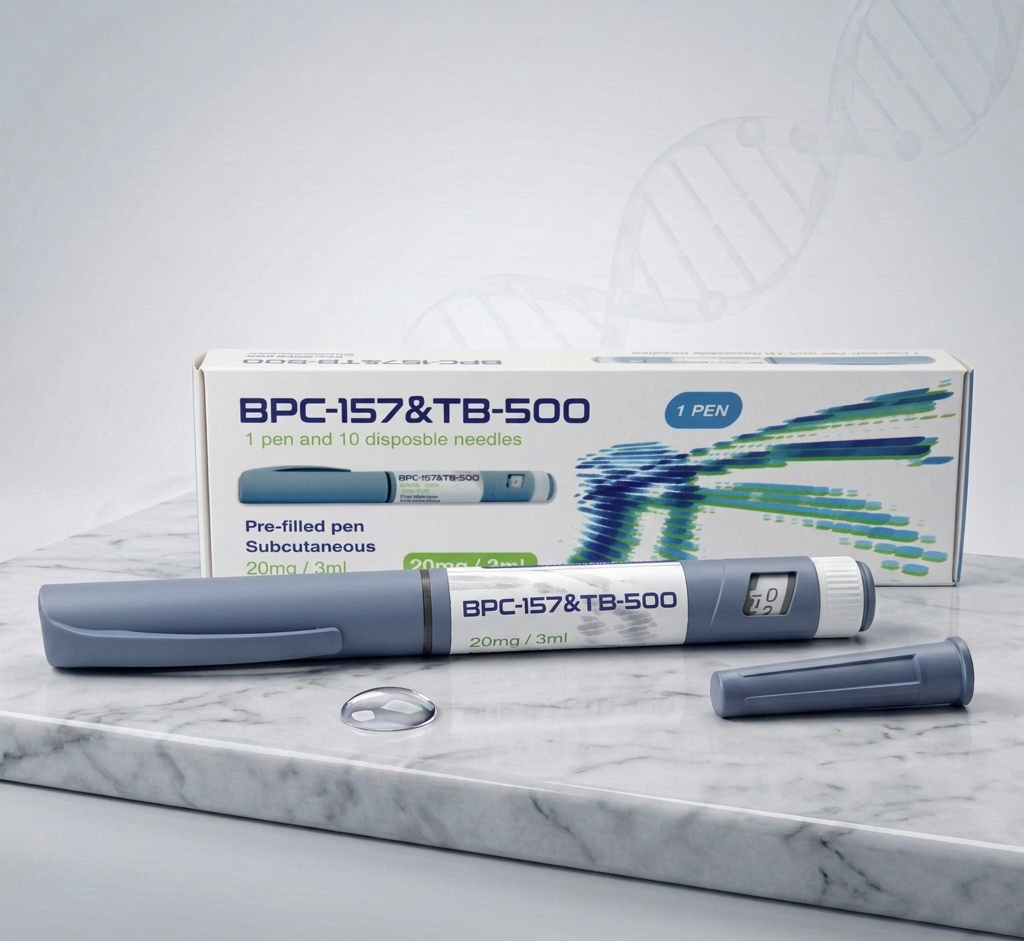
BPC-157 & TB-500 – Regenerative Research Peptide Pen (20mg / 3ml)
All products are shipped in a cooler box at the appropriate temperature.
What is BPC-157 & TB-500?
BPC-157 & TB-500 represents one of the most widely studied regenerative peptide combinations in modern research — a synergistic blend of two complementary compounds whose distinct but overlapping mechanisms of action combine to produce comprehensive tissue repair, angiogenic, and anti-inflammatory effects that neither compound achieves in isolation.
BPC-157 (Body Protection Compound-157) is a synthetic 15-amino acid peptide derived from a naturally occurring gastric juice protein. Renowned for its exceptional stability and broad cytoprotective profile, BPC-157 has been extensively investigated for its capacity to support tendon, ligament, muscle, and gastrointestinal healing through upregulation of key growth factors including VEGF and FGF, modulation of nitric oxide signaling, and targeted regulation of inflammatory pathways.
TB-500 is a synthetic analog of Thymosin Beta-4 — an endogenous peptide with fundamental roles in actin regulation, cell migration, and tissue remodeling. TB-500 promotes angiogenesis, extracellular matrix remodeling, and systemic cell recruitment to sites of injury, making it a cornerstone compound in wound healing, muscle regeneration, and tissue flexibility research.
When combined, BPC-157’s targeted cytoprotection and collagen organization complement TB-500’s systemic vascularization and cell recruitment capabilities — producing a synergistic regenerative profile that has made this blend a preferred choice for research models requiring enhanced repair kinetics and coordinated multi-tissue healing responses.
This pen delivers an ultra-high purity BPC-157 & TB-500 blend (>99%, third-party HPLC and mass spectrometry verified) in a sterile, ready-to-use 20mg / 3ml pre-filled format — the research benchmark for peptide-driven tissue regeneration investigation.
What are the benefits of BPC-157 & TB-500 in research?
The complementary mechanisms of BPC-157 and TB-500 produce a research profile that spans musculoskeletal repair, vascular biology, gastrointestinal protection, and systemic regeneration. Key areas of investigational interest include:
- Tendon, ligament & musculoskeletal repair: BPC-157 & TB-500 research has consistently demonstrated accelerated healing responses in tendon, ligament, muscle, and joint injury models — driven by BPC-157’s upregulation of local growth factors and TB-500’s enhancement of systemic cell recruitment to damaged tissue.
- Angiogenesis & vascularization: TB-500’s potent pro-angiogenic activity, complemented by BPC-157’s VEGF modulation, supports robust investigation of blood supply restoration to ischemic or injured tissues — a critical component of comprehensive healing research.
- Muscle recovery & regeneration: The blend has been widely studied in models of muscle strain, exercise-induced microtrauma, and catabolic muscle injury, with findings supporting its utility in investigations of recovery kinetics and regenerative capacity.
- Gastrointestinal protection & gut barrier repair: BPC-157’s origins as a gastric peptide make it particularly well-suited for GI research, with studies documenting its capacity to protect the gut barrier, reduce intestinal inflammation, and support mucosal healing in relevant experimental models.
- Anti-inflammatory modulation: Both compounds contribute to the regulation of pro-inflammatory signaling pathways, making the blend a valuable tool for investigations into inflammation resolution and the transition from acute injury response to tissue repair.
- Cardiac, neural, corneal & dermal repair: Research applications for this blend extend across multiple tissue types, with studies investigating BPC-157 and TB-500’s effects in cardiac injury, neuroprotection, corneal wound healing, and dermal repair models — reflecting the systemic reach of their combined mechanisms.
- Chronic & degenerative tissue models: The blend’s sustained regenerative profile makes it particularly suited to longer-duration research designs investigating chronic injury, degenerative tissue conditions, and the cellular mechanisms underlying repair failure.
Research Background & Scientific Context
BPC-157 has accumulated a substantial body of preclinical research evidence since its initial characterization, with studies spanning gastroenterology, orthopedics, sports medicine, and neuroscience documenting its consistent cytoprotective and healing-promoting properties. Its stability in physiological conditions — unusual among peptides of its class — has contributed to its widespread adoption as a research tool across diverse experimental models.
Thymosin Beta-4, from which TB-500 is derived, is one of the most abundant intracellular peptides in mammalian tissue and has been the subject of extensive research into its roles in actin dynamics, wound repair, and cardiac regeneration. TB-500’s synthetic design preserves the key active sequence responsible for Thymosin Beta-4’s biological activity while providing the stability required for consistent laboratory use.
Together, the compounds’ complementary mechanisms — BPC-157’s localized cytoprotection and growth factor regulation alongside TB-500’s systemic angiogenic and cell-migratory effects — have established this blend as a foundational combination for comprehensive regenerative research protocols. The generous 20mg / 3ml pen capacity supports extended-duration studies, higher cumulative dosing designs, and experiments requiring sustained regenerative compound exposure.
Proper Usage & Dosage Guidelines
The dosage and administration of BPC-157 & TB-500 blend for research purposes should be determined in accordance with the specific experimental protocol in use. The blend is administered via subcutaneous injection, with dosing schedules typically determined by the tissue type under investigation and the duration of the experimental model.
Pen Specifications – BPC-157 & TB-500 20mg / 3ml Pen:
The pen contains 20mg total peptide blend in 3ml solution (~6.67mg/ml), offering generous volume for extended protocols, higher cumulative dosing, and both localized and systemic research applications.
Additional Usage Notes:
- Inject into the abdomen area or the front of the thigh
- After injecting, wait 10 seconds before removing the needle
- Rotate injection sites between administrations
- Store refrigerated at all times (2–8°C); do not freeze
- Use sterile, single-use needles only — replace with each injection
- Protect from prolonged light exposure and temperature fluctuation
Possible Side Effects
The published research literature for both BPC-157 and TB-500 individually describes a favorable tolerability profile, with neither compound associated with significant systemic toxicity in preclinical models at research-relevant doses. The most commonly noted responses include mild injection site discomfort and transient fatigue. As with all peptide research compounds, individual model variability should be accounted for in experimental design, and dosing protocols should be established with reference to the available literature for each component.
What’s Included
- Reusable precision peptide pen injector
- Pre-filled BPC-157 & TB-500 peptide blend solution — 20mg total / 3ml
- Detailed laboratory usage instructions
- 10 sterile, single-use needles
Why Choose This BPC-157 & TB-500 Pen?
This BPC-157 & TB-500 blend pen is manufactured to deliver both peptide components at greater than 99% purity, independently verified by third-party HPLC and mass spectrometry analysis. The sterile, ready-to-use pre-filled pen format provides precise dosing and maximum laboratory convenience, while the high-capacity 20mg / 3ml configuration ensures ample supply for the most demanding regenerative research protocols. The classic BPC-157 + TB-500 combination remains one of the most extensively studied and reliably effective pairings in peptide research — offering cytoprotection, collagen organization, angiogenesis, and actin remodeling in a single, convenient research tool.
Explore the pinnacle of peptide-driven tissue regeneration with this legendary BPC-157 + TB-500 blend — where cytoprotection meets actin remodeling for unmatched healing and recovery research potential.
The information presented has been collected from published studies and analyses and is not intended for diagnosing, treating, or preventing any disease.
Notice: This BPC-157 & TB-500 blend is sold exclusively for in-vitro laboratory research, scientific experimentation, and analytical purposes only. It is not a pharmaceutical product, therapeutic agent, healing supplement, or compound intended for human or animal consumption, diagnosis, treatment, or any medical or veterinary application whatsoever. The purchaser assumes full responsibility for proper refrigerated storage, safe handling, legal compliance, and adherence to all applicable institutional, national, and international regulations.
Reviews
There are no reviews yet.