

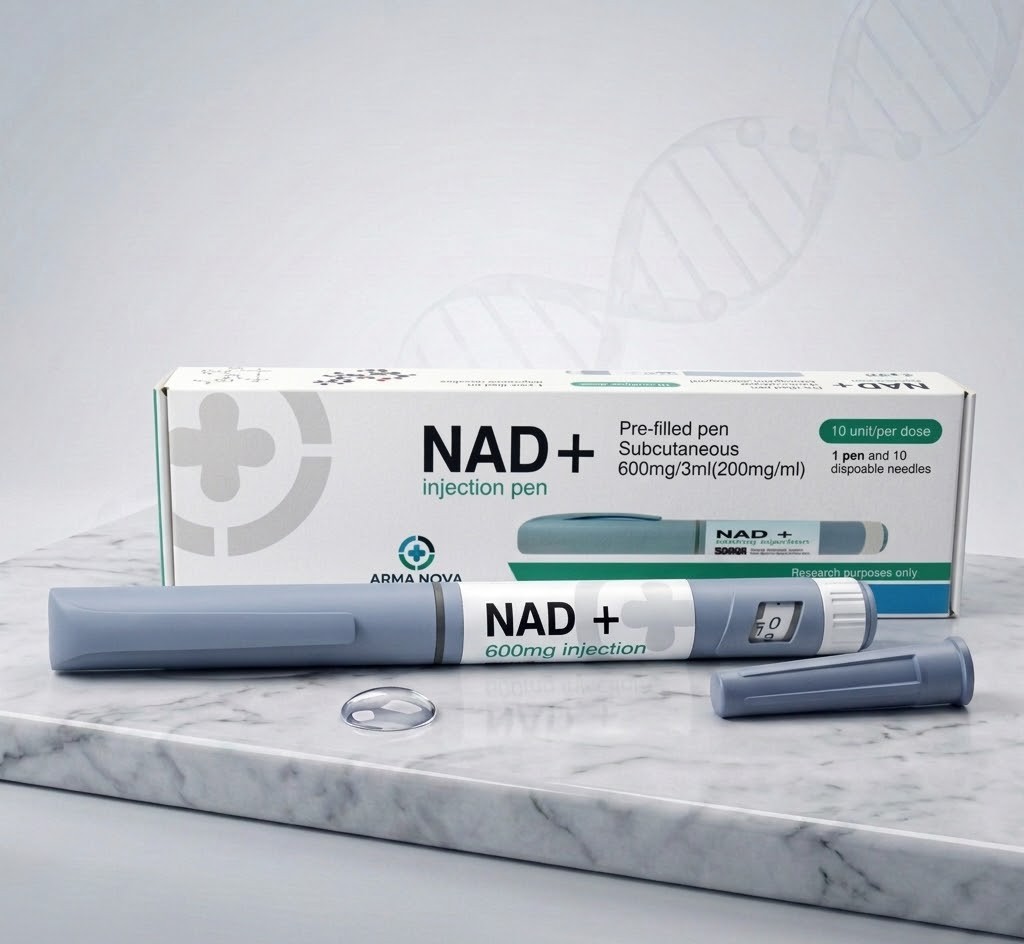
NAD+ Nicotinamide Adenine Dinucleotide – Research Pen (600mg / 3ml)
All products are shipped in a cooler box at the appropriate temperature.
What is NAD+?
Nicotinamide Adenine Dinucleotide (NAD+) is one of the most fundamental and extensively studied coenzymes in all of biology — a critical pyridine nucleotide present in every living cell, where it serves as an indispensable cofactor in hundreds of redox reactions and as the primary substrate for a set of key regulatory enzymes whose activities govern metabolism, genomic integrity, stress resistance, and the biology of aging.
In its role as an electron carrier, NAD+ facilitates the transfer of electrons through glycolysis, the tricarboxylic acid (TCA) cycle, and oxidative phosphorylation — processes that collectively underpin cellular ATP production and mitochondrial energy metabolism. Beyond its redox function, NAD+ serves as the essential substrate for three major classes of regulatory enzymes that have become central targets in aging and metabolic research:
- Sirtuins (SIRT1–7) — NAD+-dependent deacetylases and ADP-ribosyltransferases that regulate gene expression, metabolic adaptation, stress resistance, mitochondrial biogenesis, and longevity-associated pathways
- PARPs (Poly-ADP-ribose polymerases) — NAD+-consuming enzymes that sense and coordinate the cellular response to DNA damage and genomic instability
- CD38/CD157 — NAD+-consuming ectoenzymes involved in calcium signaling, immune function, and a major driver of age-associated NAD+ decline
A defining feature of NAD+ biology is its well-documented decline with age, metabolic stress, and disease states — a decline that impairs sirtuin activity, DNA repair capacity, mitochondrial function, and a broad range of downstream physiological processes. Research into exogenous NAD+ administration focuses on the restoration of depleted intracellular and extracellular NAD+ pools and the downstream biological consequences of that restoration.
This pen delivers ultra-high purity NAD+ (>99%, third-party HPLC and mass spectrometry verified) in a high-concentration, ready-to-use 600mg / 3ml pre-filled format — the research essential for investigating sirtuin activation, PARP-mediated DNA repair, mitochondrial pathway restoration, and the full spectrum of NAD+-dependent biology at the forefront of bioenergetics and aging science.
What are the benefits of NAD+ in research?
NAD+’s position at the intersection of energy metabolism, genomic maintenance, and longevity signaling gives it a uniquely broad research profile that spans mitochondrial biology, neuroscience, cardiovascular physiology, and the fundamental mechanisms of cellular aging. Key areas of investigational interest include:
- Mitochondrial biogenesis & energy metabolism: Research has consistently documented NAD+’s central role in driving mitochondrial biogenesis, enhancing ATP production efficiency, and restoring oxidative phosphorylation capacity in models of age-associated or stress-induced mitochondrial decline — making it a foundational compound for investigations into cellular bioenergetics.
- Sirtuin pathway activation: NAD+ is the essential substrate for all seven sirtuin isoforms, and its elevation has been shown to restore sirtuin activity in contexts where age- or disease-associated NAD+ depletion has impaired their function. Research has documented downstream sirtuin-mediated effects on metabolic health, insulin sensitivity, inflammatory regulation, and gene expression programs associated with longevity.
- DNA repair & genomic stability: PARP enzyme activity — critical for sensing and coordinating repair of DNA strand breaks and other genomic lesions — is directly dependent on NAD+ availability. Research into NAD+ administration has explored its capacity to support DNA repair capacity, reduce markers of genomic instability, and modulate cellular senescence in relevant experimental models.
- Neuroprotection & neurodegeneration: NAD+ has been extensively investigated in models of neurodegenerative disease, with studies exploring its neuroprotective effects in Parkinson’s, Alzheimer’s, and other neurodegeneration-relevant contexts — reflecting NAD+-dependent pathways’ fundamental importance in neuronal energy metabolism and stress resistance.
- Cardiovascular protection & vascular function: Research has documented NAD+’s favorable effects on vascular endothelial function, cardiovascular parameters, and markers of metabolic syndrome, with sirtuin-mediated anti-inflammatory and metabolic regulatory effects representing key mechanisms under investigation.
- Anti-aging & longevity research: NAD+ occupies a pivotal position in the biology of caloric restriction, exercise adaptation, and lifespan extension — three of the most extensively studied longevity-promoting interventions. Research has investigated NAD+ as a molecular link connecting these interventions to downstream sirtuin and mitochondrial pathway activation.
- Muscle function, exercise performance & sarcopenia: Studies have explored NAD+’s role in skeletal muscle metabolism, exercise performance, recovery, and the prevention of age-associated muscle loss — areas of strong relevance to both sports physiology and aging biology research programs.
- Cellular senescence modulation: NAD+ research has contributed meaningfully to the growing field of senescence biology, with investigations exploring its capacity to modulate the accumulation of senescent cells and the inflammatory senescence-associated secretory phenotype (SASP) that contributes to tissue dysfunction in aging models.
Research Background & Scientific Context
NAD+ has been studied since its discovery in 1906, but the past two decades have witnessed a dramatic expansion of research interest driven by the identification of sirtuins as NAD+-dependent longevity regulators and the subsequent mapping of NAD+’s decline as a fundamental feature of biological aging. Landmark studies by David Sinclair, Johan Auwerx, and their respective laboratories established the conceptual framework linking NAD+ depletion to age-associated metabolic and physiological decline — work that has catalyzed an extraordinarily productive global research effort into NAD+ restoration as a potential intervention in aging biology.
The field has since expanded to encompass neurodegeneration, cardiovascular disease, metabolic syndrome, DNA repair biology, and the fundamental mechanisms linking nutrition and exercise to longevity pathway activation. The 600mg / 3ml high-concentration pen format supports the higher-dose protocols, extended administration studies, and robust NAD+ elevation experiments that this research landscape increasingly demands, while the direct delivery format enables investigation of bioavailability and tissue distribution across a range of experimental models.
Proper Usage & Dosage Guidelines
NAD+ for research purposes should be handled and administered in accordance with the specific experimental protocol in use. The compound is supplied in a sterile, ready-to-use pre-filled pen and is administered via subcutaneous injection in research settings.
Pen Specifications – NAD+ 600mg / 3ml Pen:
The pen contains 600mg of NAD+ in 3ml stabilized solution (200mg/ml concentration), providing substantial capacity for higher-dose protocols, extended administration studies, and experiments requiring robust and sustained NAD+ pool elevation.
Additional Usage Notes:
- Inject into the abdomen area or the front of the thigh
- After injecting, wait 10 seconds before removing the needle
- Rotate injection sites between administrations
- Store refrigerated at all times (2–8°C); do not freeze
- Use sterile, single-use needles only — replace with each injection
- Protect from light and temperature fluctuation; NAD+ is sensitive to degradation under suboptimal storage conditions
Possible Side Effects
NAD+ has demonstrated a generally favorable tolerability profile in the published research literature. Commonly noted responses in research models include transient flushing, warmth, mild nausea, and injection site discomfort — effects most frequently associated with higher dose administrations and typically short-lived in duration. These responses are consistent with NAD+’s known vasodilatory and metabolic activation effects and generally diminish with continued administration at stable doses.
Adherence to established dosing protocols and careful titration remains the most reliable approach to managing the response profile across research settings.
What’s Included
- Reusable precision peptide pen injector
- Pre-filled NAD+ solution — 600mg / 3ml
- Detailed usage instructions
- 10 sterile, single-use needles
Why Choose This NAD+ Pen?
This NAD+ formulation is manufactured to deliver nicotinamide adenine dinucleotide at greater than 99% purity, independently verified by third-party HPLC and mass spectrometry analysis. The stabilized formulation is optimized specifically for research-grade NAD+ stability, preserving biological activity throughout the compound’s shelf life under proper refrigerated storage. The sterile, ready-to-use pre-filled pen format provides precise dosing and maximum laboratory convenience, while the high-concentration 600mg / 3ml configuration ensures the substantial compound availability demanded by higher-dose protocols and extended research designs.
Investigate the central hub of cellular metabolism and longevity signaling with NAD+ 600mg — the research essential for unlocking sirtuin, PARP, and mitochondrial pathways at the forefront of bioenergetics and aging science.
The information presented has been collected from published studies and analyses and is not intended for diagnosing, treating, or preventing any disease.
Notice: NAD+ (Nicotinamide Adenine Dinucleotide) is sold strictly and exclusively for in-vitro laboratory research, scientific experimentation, and analytical purposes only. It is not a pharmaceutical product, supplement, therapeutic agent, anti-aging treatment, or compound intended for human or animal consumption, diagnosis, treatment, or any medical or veterinary application whatsoever. The purchaser assumes full responsibility for proper refrigerated storage, safe handling, legal compliance, and adherence to all applicable institutional, national, and international regulations.
Reviews
There are no reviews yet.